Our House Antiques
Las Vegas, Nevada
Elegant Depression Era Glassware
Menu:
Etching Identification and Information Page
We are trying to provide a good photograph of commonly found etched patterns, made by Fostoria, Cambridge, Tiffin, New Martinsville, Heisey, Duncan and Miller, etc. We believe that it is useful to have a catalog of these patterns available to the on-line community. This page is a work in progress, as we will be continually adding to it as we find or create good pattern shots. You can use the table of contents (below) to jump to a specific section. Enjoy!
- Fostoria "June"
- Fostoria "Versailles"
- Fostoria "Kashmir"
- Fostoria "Trojan"
- Fostoria "Navarre"
- Fostoria "Meadow Rose"
- Fostoria "Chintz"
- Fostoria "Willowmere"
- Cambridge "Rose Point"
- Cambridge "Wildflower"
- New Martinsville etched patterns - Identification
- Comparison of Fostoria's #5098 Goblet, Claret and Wine
- Comparison of Fostoria's #5098 High Sherbet, Cocktail and Claret
- Comparison of Fostoria's #5098 footed water and parfait
- Side-by-side comparison of Fostoria's #5099 footed tumblers
Fostoria "June"
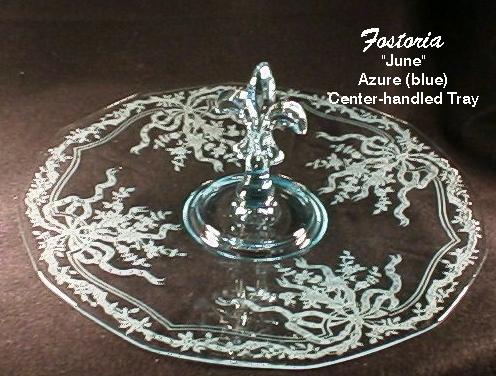 This first pattern
is Fostoria's "June". This was, and is, one of Fostoria's
most popular patterns. It is sometimes confused with a
later Fostoria pattern known as "Romance", as both patterns
consist of a large bow, surrounded by flowers. To see a
side-by-side comparison of "June" and "Romance", go to our
pattern
comparison page. The years of general production of
pieces of Fostoria's "June" were:
This first pattern
is Fostoria's "June". This was, and is, one of Fostoria's
most popular patterns. It is sometimes confused with a
later Fostoria pattern known as "Romance", as both patterns
consist of a large bow, surrounded by flowers. To see a
side-by-side comparison of "June" and "Romance", go to our
pattern
comparison page. The years of general production of
pieces of Fostoria's "June" were:
Topaz (yellow): 1929-1938
Gold Tint (yellow): 1938-1944
Rose (pink): 1928-1944
Azure (blue): 1928-1944
Crystal: 1928-1952
Notice that the yellow color underwent a name change in 1938. All indications are that the formula was the same and only the name of the color changed in Fostoria literature. Note also that there was a Fostoria "Replacement Service" for stemware in "June" which was offered once a year, in the winter, from the time the pattern was discontinued up to about 1960. One final note: although crystal "June" was produced over a long period of time, it was apparently not a big seller, as it is relatively scarce today. The most popular colors are pink and blue. Not surprising, the most expensive colors are also pink and blue, followed by crystal, and then by yellow. Yellow "June" is one of the better bargains in Elegant glassware.
All stemware for the "June" pattern was produced on a single Fostoria blank, Number 5098 (some authors use 5298). That blank is illustrated in the picture further along on this page comparing Fostoria's goblet, claret and wine sizes. The stemware in the illustration is the "June" pattern in crystal.
Fostoria "Versailles"
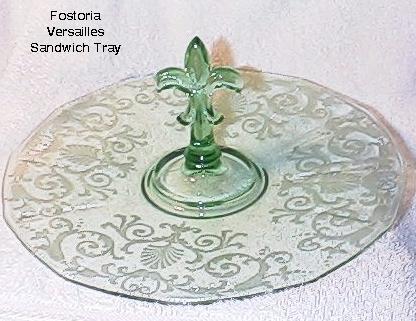 This next pattern is
Fostoria's "Versailles". This was, and is, one of
Fostoria's most popular patterns. It was manufactured
during the same time period as the "June" pattern, and was
also made in four colors, three of which were the same as
"June". The years of general production of pieces of
Fostoria's "Versailles" were:
This next pattern is
Fostoria's "Versailles". This was, and is, one of
Fostoria's most popular patterns. It was manufactured
during the same time period as the "June" pattern, and was
also made in four colors, three of which were the same as
"June". The years of general production of pieces of
Fostoria's "Versailles" were:
Topaz (yellow): 1929-1938
Gold Tint (yellow): 1938-1944
Rose (pink): 1928-1944
Azure (blue): 1928-1944
Green: 1928-1944
Notice that the yellow color underwent a name change in 1938, for this pattern, too. Note also that there was a Fostoria "Replacement Service" for stemware in "Versailles" which was offered once a year, in the winter, from the time the pattern was discontinued up to about 1960. The most popular colors are pink and blue, and, this should come as no surprise, the most expensive colors, as in Fostoria's "June", are pink and blue, but for "Versailles" we also add green, and then yellow. Yellow "Versailles" may be the best bargain in Elegant glassware. "Versailles" was not made in crystal. It appears that there was not a lot of "Versailles" produced in green, either, as that color tends to be fairly scarce in today's market.
Stemware for the "Versailles" pattern was produced on two different Fostoria blanks, Number 5098 and 5099. Only the yellow color was produced on the 5099 blank, while the other three colors of "Versailles" were made on the 5098 blank, the same one used for "June".
Fostoria "Kashmir"
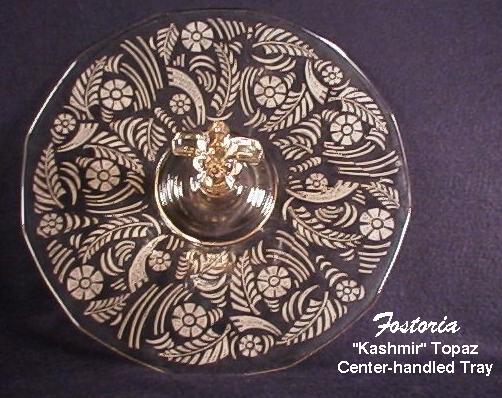 Here we have
Fostoria's "Kashmir" etching. This very attractive pattern
was manufactured during the same time period (though not
for as long) as "June" and "Versailles", but did not match
the popularity of those patterns. The years of general
production of pieces of Fostoria's "Kashmir"
were:
Here we have
Fostoria's "Kashmir" etching. This very attractive pattern
was manufactured during the same time period (though not
for as long) as "June" and "Versailles", but did not match
the popularity of those patterns. The years of general
production of pieces of Fostoria's "Kashmir"
were:
Topaz (yellow): 1931-1934
Azure (blue): 1931-1934
Green : 1931-1934
The most popular color in this pattern for collectors is yellow, simply because there is a lot more of it around. Actually, the blue pieces tend to be pricier than their counterpart in yellow, but that is due to scarcity and collector demand. Green pieces are few and far between in "Kashmir", and pricing is all over the place with green, because of its scarcity. Actually, "Kashmir" is not seen as often as some of Fostoria's other etched patterns, probably because it was not produced for as long a period of time.
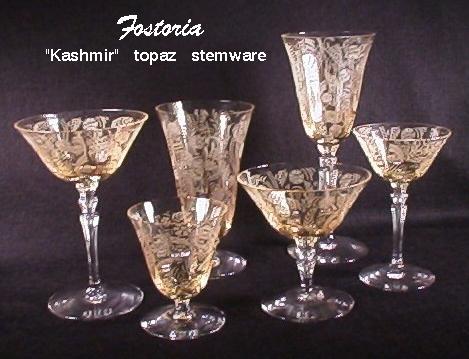
Stemware for the "Kashmir" pattern was produced on both Fostoria blank number 4120 and blank number 5099. Some of the pieces on the 5099 blank are illustrated in this link, but we do not yet have a photograph of "Kashmir" on the 4120 blank.
Fostoria"Trojan"
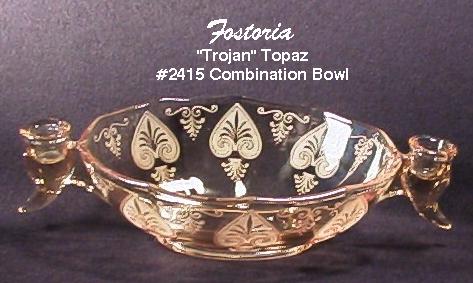 This next
pattern is Fostoria's "Trojan". The pattern was
manufactured during the same time period as the "June" and
"Versailles" patterns, but did not match the popularity of
"June" or "Versailles". The years of general production of
pieces of Fostoria's "Trojan" were:
This next
pattern is Fostoria's "Trojan". The pattern was
manufactured during the same time period as the "June" and
"Versailles" patterns, but did not match the popularity of
"June" or "Versailles". The years of general production of
pieces of Fostoria's "Trojan" were:
Topaz (yellow): 1929-1938
Gold Tint (yellow): 1938-1944
Rose (pink): 1928-1935
Notice that the yellow color underwent a name change in 1938, for this pattern, too. Note also that there was a Fostoria "Replacement Service" for stemware in "Trojan" which was offered once a year, in the winter, from the time the pattern was discontinued up to about 1960. The most popular color in this pattern for collectors is yellow, simply because there is a lot more of it around. Actually, the pink pieces tend to be quite a bit higher than their counterpart in yellow, but that is due to scarcity (fewer years of production) and collector demand.
Stemware for the "Trojan" pattern was produced only on Fostoria blank Number 5099, in both colors. To see the general shape of these stems follow this link to see the "Kashmir" stems pictured on the same 5099 blank.
Fostoria "Navarre"
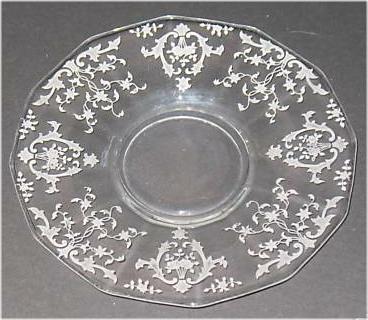 This is the
"Navarre" pattern, the most popular etched pattern produced by the Fostoria
Glass Company. It was introduced in 1936 and was continuously produced until
1982. In 1982, Fostoria discontinued manufacturing handblown glassware, and
the "Navarre" pattern was sold to Lenox Glass Company. Lenox continued to make
"Navarre" until 1992.
This is the
"Navarre" pattern, the most popular etched pattern produced by the Fostoria
Glass Company. It was introduced in 1936 and was continuously produced until
1982. In 1982, Fostoria discontinued manufacturing handblown glassware, and
the "Navarre" pattern was sold to Lenox Glass Company. Lenox continued to make
"Navarre" until 1992.
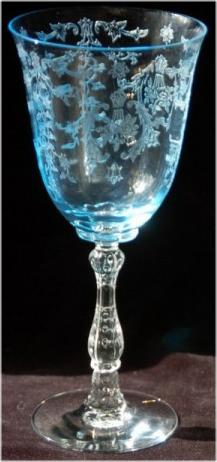 "Navarre" was initially produced in crystal only. It wasn't until 1973 that
Fostoria introduced "Navarre" stemware (only) in colors - blue and pink, with
crystal stem and foot. The blue "Navarre" goblet is shown in the photo, below
right. The pink color used for "Navarre" is a very different color than what Fostoria
used for older patterns like "June" and "Versailles." When Lenox took over the
pattern, their blue color was identical to Fostoria's, but the Lenox pink is a
distinctly different color than the pink produced by Fostoria. Actually, there's
not a whole lot of either color out there.
"Navarre" was initially produced in crystal only. It wasn't until 1973 that
Fostoria introduced "Navarre" stemware (only) in colors - blue and pink, with
crystal stem and foot. The blue "Navarre" goblet is shown in the photo, below
right. The pink color used for "Navarre" is a very different color than what Fostoria
used for older patterns like "June" and "Versailles." When Lenox took over the
pattern, their blue color was identical to Fostoria's, but the Lenox pink is a
distinctly different color than the pink produced by Fostoria. Actually, there's
not a whole lot of either color out there.
"Navarre" was offered in a complete dinnerware line (crystal only) and with many accessory pieces. Strangely, it is one of the few Fostoria patterns which does NOT include a center-handled tray. There were some interesting sizes of stemware added late in the production of the pattern - the magnum and continental champagne in 1975, the brandy inhaler in 1976 and the cocktail sherry in 1980. Since the pattern was sold to Lenox in 1982 and Lenox did not make any of these sizes, they tend to be rather scarce (and pricey) in today's market.
Fostoria "Meadow Rose"
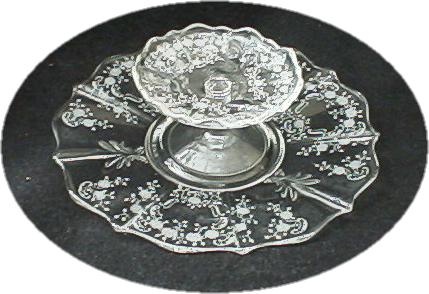 "Meadow Rose" is another of Fostoria's popular etched
patterns, and is often confused with "Navarre" by both collectors and some
dealers. Part of the problem is that the two patterns used the exact same
stemware line and dinnerware line, and part of the problem is that
both etchings are somewhat
similar. The easiest way to distinguish them is that "Navarre" has flowers
inside the "parentheses" and on "Meadow Rose" the center is empty. By
"parentheses" I mean the curved pieces in the etched pattern.
"Meadow Rose" is another of Fostoria's popular etched
patterns, and is often confused with "Navarre" by both collectors and some
dealers. Part of the problem is that the two patterns used the exact same
stemware line and dinnerware line, and part of the problem is that
both etchings are somewhat
similar. The easiest way to distinguish them is that "Navarre" has flowers
inside the "parentheses" and on "Meadow Rose" the center is empty. By
"parentheses" I mean the curved pieces in the etched pattern.
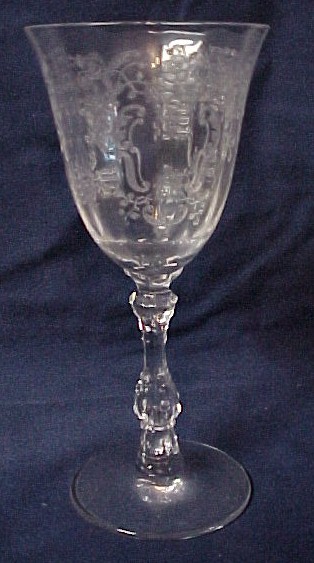 "Meadow Rose"
was introduced in 1936 and production continued in crystal into the 1970s. Most of
the pieces were made on Fostoria's "Baroque" dinnerware pattern, with occasional
pieces added in some of Fostoria's other lines. "Meadow Rose"
was also made in azure blue (both stemware and tableware) in the early years,
with the blue being discontinued around 1943, while crystal production continued. If
you find "Meadow Rose" stemware in blue, it is "early production", while if you
find "Navarre" stemware in blue, it is "late production." All blue "Meadow Rose"
is considered "scarce" in today's market.
"Meadow Rose"
was introduced in 1936 and production continued in crystal into the 1970s. Most of
the pieces were made on Fostoria's "Baroque" dinnerware pattern, with occasional
pieces added in some of Fostoria's other lines. "Meadow Rose"
was also made in azure blue (both stemware and tableware) in the early years,
with the blue being discontinued around 1943, while crystal production continued. If
you find "Meadow Rose" stemware in blue, it is "early production", while if you
find "Navarre" stemware in blue, it is "late production." All blue "Meadow Rose"
is considered "scarce" in today's market.
Fostoria "Chintz"
 This is
Fostoria's "Chintz" pattern. It is an all over pattern,
consisting of vines and small roses. The pattern is often
confused with a number of other patterns made by different
companies. Click on the photograph of the tray or of the
goblet and you'll see an enlarged set of photographs that
enable you to see the whole pattern. The shape of the goblet,
on Fostoria's #6016 stemware blank, is enough to distinguish
it from any of the other patterns that "Chintz" is often
confused with.
This is
Fostoria's "Chintz" pattern. It is an all over pattern,
consisting of vines and small roses. The pattern is often
confused with a number of other patterns made by different
companies. Click on the photograph of the tray or of the
goblet and you'll see an enlarged set of photographs that
enable you to see the whole pattern. The shape of the goblet,
on Fostoria's #6016 stemware blank, is enough to distinguish
it from any of the other patterns that "Chintz" is often
confused with.
"Chintz"
was manufactured from 1940 to 1970, and only in crystal.
Not all pieces were made
for the full thirty year production run. In fact, some items were made for only a
very short time, making them fairly pricey. Dinnerware was
done on Fostoria's "Baroque" blank, and unfortunately, the
"Chintz" dinner plate measures only 9 1/2" in diameter - a
bit small for today's table. There is a full complement of table settings
and serving pieces, and a number of stunning vases and candleabra.
"Chintz" is one of
Fostoria's most beautiful etched patterns, and the goblet design is
a work of art.
Fostoria "Willowmere"
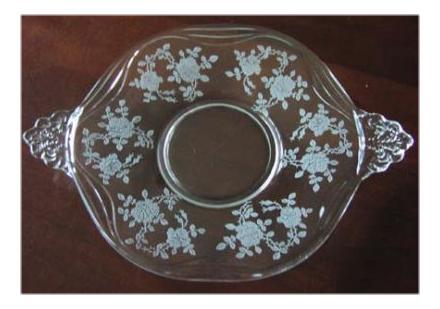 "Willowmere"
was introduced around 1938, produced only in crystal. Production continued
into the 1950s for most pieces, with a very few continued into the late 1960s.
Dinnerware was made on Fostoria's "Coronet" blanks, with only a very few
occasional pieces made on any of the other blanks. The table setting included
typical bread/butter, salad, luncheon and dinner plates, but the dinner plate
was only 9½ inches in diameter - small by today's standards.
"Willowmere"
was introduced around 1938, produced only in crystal. Production continued
into the 1950s for most pieces, with a very few continued into the late 1960s.
Dinnerware was made on Fostoria's "Coronet" blanks, with only a very few
occasional pieces made on any of the other blanks. The table setting included
typical bread/butter, salad, luncheon and dinner plates, but the dinner plate
was only 9½ inches in diameter - small by today's standards.
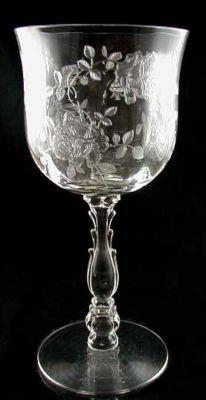 The goblet used with the "Willowmere" pattern was Fostoria's Number 6024, which
has a distinctive molded stem and a U-shaped bowl that is quite different from
most other Fostoria stemware lines. The pattern consists of bold roses on the
vine, and the size and shape of the roses cause both dealers and collectors to
often confuse the pattern with Heisey's "Rose" pattern. Careful examination of
the stem provides the clue - "Willowmere" stems do NOT have a "rose" molded into
the stem, while the Heisey product has a "rose" as an integral part of the base
of the stem. This pattern is not as abundant as some other Fostoria patterns,
but is definitely not considered "rare."
The goblet used with the "Willowmere" pattern was Fostoria's Number 6024, which
has a distinctive molded stem and a U-shaped bowl that is quite different from
most other Fostoria stemware lines. The pattern consists of bold roses on the
vine, and the size and shape of the roses cause both dealers and collectors to
often confuse the pattern with Heisey's "Rose" pattern. Careful examination of
the stem provides the clue - "Willowmere" stems do NOT have a "rose" molded into
the stem, while the Heisey product has a "rose" as an integral part of the base
of the stem. This pattern is not as abundant as some other Fostoria patterns,
but is definitely not considered "rare."
Cambridge "Rose Point"
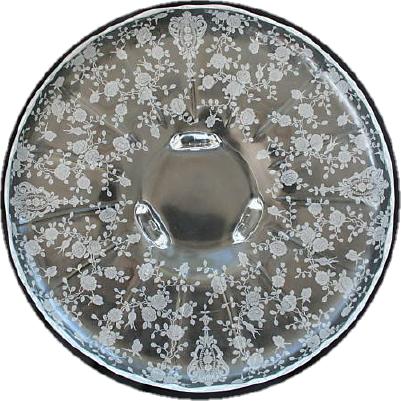 Cambridge "Rosepoint" or, more properly, "Rose Point"
was introduced in 1935, at the same time that Pope-Gosser China Company introduced
a dinnerware line of the same name. R. Wallace & Sons introduced a matching
line of silverware during the same time period. This allowed one to have the same
design on glass, china dinnerware and silverware.
Cambridge "Rosepoint" or, more properly, "Rose Point"
was introduced in 1935, at the same time that Pope-Gosser China Company introduced
a dinnerware line of the same name. R. Wallace & Sons introduced a matching
line of silverware during the same time period. This allowed one to have the same
design on glass, china dinnerware and silverware.
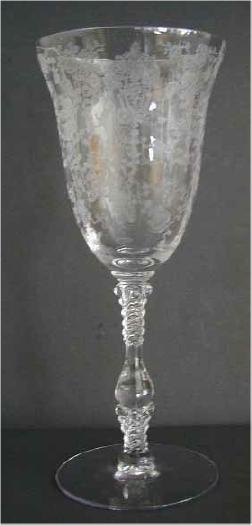 "Rose Point" was Cambridge's most popular etched pattern, and it remained in the
product line until the company closed its doors in 1958. Imperial Glass Company
purchased the Cambridge assets and actually produced "Rose Point by Imperial" for
about ten years. "Rose Point" was produced on at least three different tableware
"lines" and at least three different stemware "lines" during the course of its
production life. A collector trying to obtain one piece of everything that was
made in "Rose Point" would spend many years and still would likely not have
accumulated everything. Each year, it seems, another "unknown" piece of "Rose
Point" emerges. It's been said that if Cambridge made a piece of glass, sooner or
later, it would appear with "Rose Point" on it. The stem shown at right is line
number 3121, the most commonly found stem, but you can find it on the #3500, #3106,
#3011 ("nude stem") and the cocktail in #3104 to match with the Martini pitcher.
"Rose Point" was Cambridge's most popular etched pattern, and it remained in the
product line until the company closed its doors in 1958. Imperial Glass Company
purchased the Cambridge assets and actually produced "Rose Point by Imperial" for
about ten years. "Rose Point" was produced on at least three different tableware
"lines" and at least three different stemware "lines" during the course of its
production life. A collector trying to obtain one piece of everything that was
made in "Rose Point" would spend many years and still would likely not have
accumulated everything. Each year, it seems, another "unknown" piece of "Rose
Point" emerges. It's been said that if Cambridge made a piece of glass, sooner or
later, it would appear with "Rose Point" on it. The stem shown at right is line
number 3121, the most commonly found stem, but you can find it on the #3500, #3106,
#3011 ("nude stem") and the cocktail in #3104 to match with the Martini pitcher.
Cambridge "Wildflower"
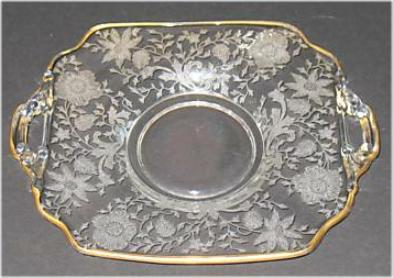 "Wildflower"
was introduced sometime in the early 1930s and was produced continuously
until sometime in the mid-1950s (Cambridge closed in 1958). This pattern
consists of a full dinnerware line, with matching service and utility
pieces. Most "Wildflower" production was in crystal, but you may run into
an occasional colored piece, notably black with gold encrustation (definitely
a scarce and pricey item if you find one).
"Wildflower"
was introduced sometime in the early 1930s and was produced continuously
until sometime in the mid-1950s (Cambridge closed in 1958). This pattern
consists of a full dinnerware line, with matching service and utility
pieces. Most "Wildflower" production was in crystal, but you may run into
an occasional colored piece, notably black with gold encrustation (definitely
a scarce and pricey item if you find one).
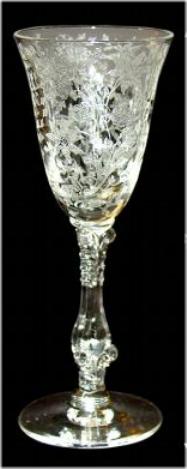 The goblet most seen with the "Wildflower" pattern is the #3121 line, frequently
seen with Cambridge's "Rose Point" pattern. Other stemware lines that were
etched with "Wildflower" were #3116, #3725 and two sizes of tumbler in #7801.
Cambridge also sold the
"Wildflower" goblets with gold rim and gold ring around the foot. Plates and
serving pieces were similarly decorated (see the plate, above left, for an
example). "Wildflower" was produced in sufficient quantities that one would
have little trouble accumulating a set in the pattern.
The goblet most seen with the "Wildflower" pattern is the #3121 line, frequently
seen with Cambridge's "Rose Point" pattern. Other stemware lines that were
etched with "Wildflower" were #3116, #3725 and two sizes of tumbler in #7801.
Cambridge also sold the
"Wildflower" goblets with gold rim and gold ring around the foot. Plates and
serving pieces were similarly decorated (see the plate, above left, for an
example). "Wildflower" was produced in sufficient quantities that one would
have little trouble accumulating a set in the pattern.
New Martinsville patterns - Identification
These three patterns by New Martinsville are commonly found, but until recently, there were no books which showed the patterns and identified them by name and manufacturer.
- New Martinsville "Prelude"

- New Martinsville "Meadow Wreath"

- New Martinsville "Florentine"

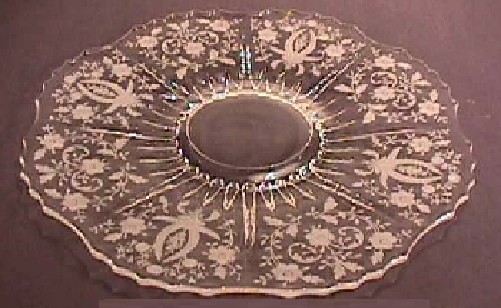
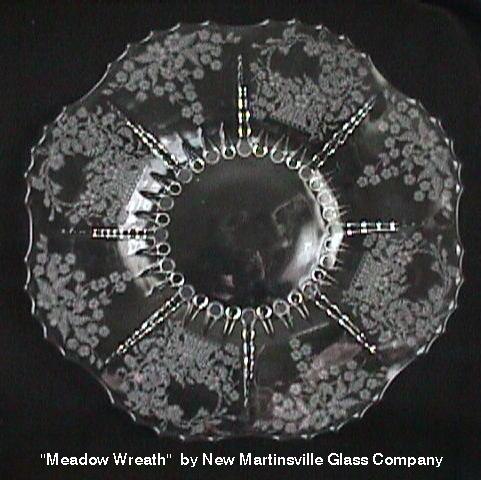

The thumbnails are somewhat difficult to see, so click on each to see a larger image of the pieces illustrated. All three patterns were introduced in the 1930's, in crystal only, and they were continued into the 1950's, after New Martinsville Glass Company changed their name to Viking Glass Company. You can find a good listing of pieces in "Prelude" in Gene Florence's book "Collectible Glassware of the 40's, 50's and 60's", Fifth edition.
Comparison of Fostoria glassware sizes
Fostoria #5098 Goblet, Claret and Wine
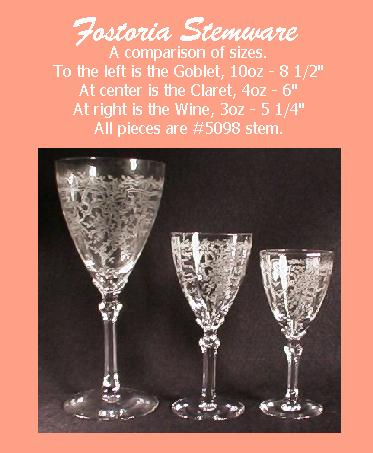 This first picture
is intended to show you the difference between the goblet,
claret and wine in Fostoria stemware.
This first picture
is intended to show you the difference between the goblet,
claret and wine in Fostoria stemware.
When the glass was manufactured, Prohibition was in effect. The tallest "goblet" that was sold by Fostoria was referred to as a "water goblet", because, of course, one wouldn't put wine in it during Prohibition. This goblet has a 10 ounce capacity, and in today's world it is principally used to serve wine.
The smallest stem, on the right, was the "wine", and it was only intended for use for "sacramental wine". Yeah, right. But for quite a while, this was the only size "wine" that was sold. The capacity is a very tiny 3 ounces. Today, the "wine" would likely be used to serve dessert wine.
In the middle, you'll see the "claret". This size was probably made for distribution on the west coast, since today that's where most of them are found for some reason. The capacity is a more respectable 4 ounces. It was intended for use (after Prohibition was repealed) to hold a "claret" or blended French red wine. Today, it has a similar use, although due to its scarcity (and resulting high price), most people don't bother to add this size to their collection. Clarets, in most Fostoria etched patterns, tend to run over $100 each. A lot to pay for a four ounce wine...
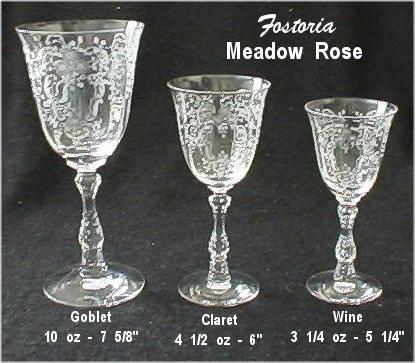
The picture illustrates Fostoria's "June" pattern and stemware line #5098. The relative sizes are similar in other Fostoria stemware lines, although the shapes of the pieces will vary. For example, here are the same three stems in Fostoria's "Meadow Rose" pattern. And here is a photograph of pieces of Fostoria's #5099 stemware line in Fostoria's topaz "Kashmir" etching. The stems in the "Kashmir" picture are, left to right, tall sherbet, iced tea, oyster cocktail, low sherbet, goblet, cocktail.
The 5098 and 5099 are the two principal stemware lines used for most of Fostoria's colored etched patterns. There are some other stems which were used, but for less popular (and harder to find) patterns. And not all stemware lines had both the claret and wine sizes.
Fostoria #5098 High Sherbet, Cocktail and Claret
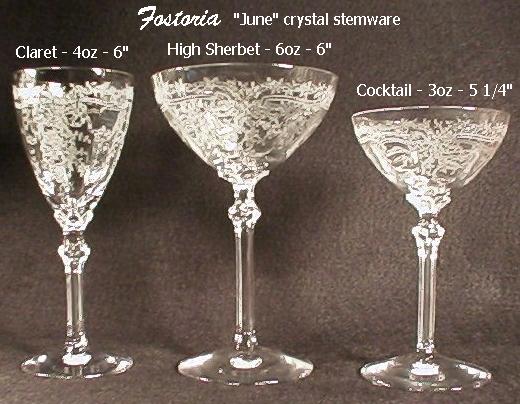 Sometimes folks get a
bit confused with the three stems illustrated in this
photograph. When you see a picture of the pieces set
side-by-side, you should be easily able to distinguish the
"claret" from the other two pieces, since the "claret" looks
a whole lot like a miniature version of the "goblet", while
the other two pieces have a completely different bowl
shape.
Sometimes folks get a
bit confused with the three stems illustrated in this
photograph. When you see a picture of the pieces set
side-by-side, you should be easily able to distinguish the
"claret" from the other two pieces, since the "claret" looks
a whole lot like a miniature version of the "goblet", while
the other two pieces have a completely different bowl
shape.
Notice that the "high sherbet" and "cocktail" have a flattened bowl. They are shaped very much alike, but the "cocktail" is simply a smaller size. The "high sherbet" is also called a "saucer champagne" or just "champagne" by some collectors, but the original Fostoria name was "high sherbet".
We've seen folks identify the "high sherbet" on eBay as a "claret", so this photograph was created partly for the purpose of illustrating the difference. Both the "high sherbet" and the "claret" are 6" in height, but the bowl shape and capacity ("claret" - 4oz, "high sherbet - 6oz) differentiate the two pieces. This photograph illustrates the "June" pattern in crystal, but the size comparison applies to all Fostoria stems. Refer to the pages immediately following the "Fairfax" pattern in Gene Florence's "Elegant Glassware of the Depression Era" (any edition), as he carefully illustrates all of the different stemware sizes in Fostoria's stemware lines.
Fostoria #5098 footed water andparfait
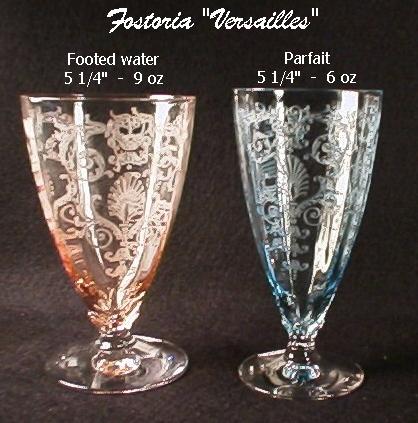 This picture
illustrates the difference between the "footed water" and the
"parfait" in Fostoria's stemware lines. These two pieces have
the same 5 1/4" height, but differ in capacity. The water has
a 9oz capacity, while the parfait is thinner and has only a
6oz capacity.
This picture
illustrates the difference between the "footed water" and the
"parfait" in Fostoria's stemware lines. These two pieces have
the same 5 1/4" height, but differ in capacity. The water has
a 9oz capacity, while the parfait is thinner and has only a
6oz capacity.
The major difference between the two sizes is PRICE!!
The footed water is almost always priced at less than HALF the price of the parfait. The parfait is definitely scarce (I use that term as opposed to rare, which is an overused term, in my opinion).
The best method to be sure which size you have is to fill the piece to the top with water, then dump the water into a measuring cup and read the results. If there is 9 ounces of water, you have a footed water. If there is 6 ounces, then you have a parfait. You can also measure across the top of the piece -- the parfait is about 2 1/2" in diameter, the water is about 3" in diameter.
Fostoria #5099 footed tumblers
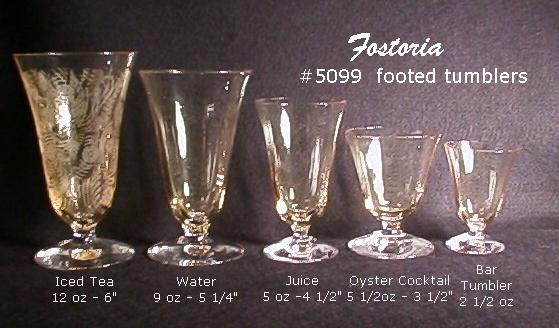 This picture shows you
five pieces of Fostoria's #5099 stemware, in this case, the
footed tumblers. The characteristic "deco" stem of the #5099
line is not as apparent on the footed tumblers. The largest
tumbler, the iced tea, is shown in the "Kashmir" etch, while
the other pieces are all the plain "topaz" colored stemware
of the #5099 stemware line. The footed tumblers are of
similar relative size in Fostoria's #5098 stemware line, but
the shape of the bowl is different, and you can see that by
the illustrations of other pieces in the #5098 line shown
elsewhere on this page. Note also that the "parfait" has a
short (approximately 1 inch) stem with the three "cascades"
typical of the goblets in the #5099 line, while on the #5098
line, the "parfait" looks like all of the other footed
tumblers.
This picture shows you
five pieces of Fostoria's #5099 stemware, in this case, the
footed tumblers. The characteristic "deco" stem of the #5099
line is not as apparent on the footed tumblers. The largest
tumbler, the iced tea, is shown in the "Kashmir" etch, while
the other pieces are all the plain "topaz" colored stemware
of the #5099 stemware line. The footed tumblers are of
similar relative size in Fostoria's #5098 stemware line, but
the shape of the bowl is different, and you can see that by
the illustrations of other pieces in the #5098 line shown
elsewhere on this page. Note also that the "parfait" has a
short (approximately 1 inch) stem with the three "cascades"
typical of the goblets in the #5099 line, while on the #5098
line, the "parfait" looks like all of the other footed
tumblers.